Introduction: Why Choosing the Wrong Agency Can Cost You Everything
In 2026, hiring a digital marketing agency is easy.
Hiring the right one? That’s where most businesses fail.
Every year, businesses waste thousands — sometimes millions — on agencies that:
Overpromise and underdeliver
Focus on vanity metrics instead of revenue
Use outdated strategies that stopped working years ago
If you’re reading this, you’re already smarter than most.
This guide will show you exactly how to choose the right digital marketing agency in 2026, what red flags to avoid, what questions to ask, and how to know if an agency is worth your money — before you sign the contract.
1. First, Be Clear About Your Business Goals (Most People Skip This)
Before you even look at agencies, answer this:
👉 What do you actually want to achieve?
Examples:
More qualified leads?
Higher conversion rates?
Brand visibility?
SEO growth?
Paid ads ROI?
❌ “I want more traffic” is NOT a goal ✅ “I want 50 qualified leads per month from SEO” is a goal
Why this matters: A good agency will align strategy with goals. A bad agency will sell you whatever service they’re best at.
2. Understand the Types of Digital Marketing Agencies
Not all agencies are the same.
🔹 Full-Service Agencies
Handle everything: SEO, ads, content, design, CRO ✔ Best for scaling businesses ❌ Can be expensive
🔹 Niche Agencies
Specialise in one thing (SEO-only, Ads-only) ✔ Deep expertise ❌ Limited scope
🔹 Industry-Specific Agencies
Focus on one industry (eCommerce, SaaS, Real Estate) ✔ Faster results ✔ Better understanding of your market
👉 Pro Tip: In 2026, specialised full-service agencies outperform generic ones.
3. Check Results — Not Promises
Any agency can say:
“We grow brands.”
Very few can prove it.
What to Look For:
✔ Real case studies ✔ Clear before-and-after data ✔ Metrics tied to revenue, not likes
Red Flag 🚩
“We can’t share results due to NDA” (some NDAs are real, but not all)
No screenshots, no data, no timelines
Good agencies show numbers. Great agencies explain the strategy behind them.
4. Ask These 7 Critical Questions Before Hiring an Agency
Use this checklist 👇
What does success look like in the first 90 days?
How do you measure ROI?
Who will actually work on my account?
How often will we communicate?
What tools do you use?
What happens if results don’t improve?
Have you worked with similar businesses before?
If answers are vague → walk away.
5. Transparency Is Non-Negotiable in 2026
A serious agency will: ✔ Share processes ✔ Explain strategy clearly ✔ Provide regular reports ✔ Be honest about timelines
❌ “Trust us, it takes time” (without explanation) ❌ No access to dashboards ❌ Confusing reports
Transparency builds trust. Lack of it destroys businesses.
6. Pricing: Cheap Agencies Are the Most Expensive Mistake
Let’s be honest.
Typical Agency Pricing in 2026:
SEO: $1,000 – $5,000/month
Paid Ads Management: 10–20% of ad spend
Full-Service Growth: $3,000 – $15,000/month
If an agency is very cheap, ask:
How many clients do they manage?
Who actually does the work?
Are strategies customised or copied?
👉 Remember: A $500 agency that fails costs more than a $5,000 agency that works.
7. Culture Fit & Communication Matter More Than You Think
You’ll work with this agency for months — maybe years.
Ask yourself:
Do they listen?
Do they challenge bad ideas?
Do they explain things simply?
The best agencies act like partners, not vendors.
8. Signs You’ve Found the Right Digital Marketing Agency
You’ve found a good agency if they: ✔ Ask deep questions about your business ✔ Don’t promise instant results ✔ Talk about systems, not hacks ✔ Focus on long-term growth
Great agencies say:
“Here’s what we can realistically achieve, and here’s how.”
Final Thoughts: Choose Smart, Grow Faster
Choosing the right digital marketing agency in 2026 isn’t about hype.
It’s about:
Strategy
Transparency
Proven execution
Long-term thinking
If you choose right, your agency becomes a growth engine. Choose wrong, and it becomes a cost center.
Not sure if your current marketing is working?
Book a Free Growth Strategy Call
We’ll audit your website, SEO, and funnel — and show you exactly what’s holding your growth back.
Introduction: Your Digital Foundation in a Competitive Market
In today’s fiercely competitive real estate landscape, simply having an online presence is no longer enough. The digital world is where buyers and sellers first connect with properties and professionals, and their expectations are higher than ever. Consider this: a staggering 75% of users judge a company’s credibility based on its website design. An outdated, slow, or difficult-to-navigate website can instantly signal untrustworthiness, causing potential clients to look elsewhere before they even see your listings. This means missed opportunities and lost sales.
For real estate professionals, a fragmented or generic approach to online strategy is a recipe for stagnation. The ability to attract, engage, and convert leads hinges on a robust, strategically developed website that acts as your primary digital asset. This isn’t just about showcasing properties; it’s about building trust, demonstrating expertise, and providing an unparalleled user experience that sets you apart.
This guide will explore how strategic web development, combined with targeted SEO and dynamic digital marketing, can transform your online presence from a mere brochure into a powerful lead-generating machine. We’ll delve into the essential elements that make a real estate website truly impactful, address common challenges, and outline actionable strategies to ensure your digital footprint leads to tangible business growth.
Section 1: Your Digital Headquarters: Why a Custom Real Estate Website is a Must-Have
Your website is often the very first impression a potential client has of your brand. In real estate, where trust and professionalism are paramount, this first impression can make or break a deal.
Building Credibility and Trust from the First Click
As mentioned, a significant majority of users base their judgment of a company’s credibility on its website design. An outdated or unprofessional site can lead visitors to perceive your business as untrustworthy, causing them to leave before exploring your offerings. Conversely, a well-developed, modern, and intuitively designed website instantly establishes credibility, inviting users to explore with confidence. This foundational trust is crucial for all subsequent engagement and conversion efforts.
Unparalleled Control and Customization
Unlike templated or proprietary platforms that offer limited customization, owning your custom real estate website gives you complete control over every aspect of your online presence. This includes your branding, messaging, unique features, layout, and overall design. You’re not bound by standardized layouts or minor tweaks; you can tailor your site to perfectly reflect your brand identity and cater to your specific target audience. This level of control ensures your website truly represents your unique value proposition in the market.
Standing Out in a Crowded Market
In a sea of real estate agents, many of whom use “cookie-cutter” websites with identical content, standing out is key to being memorable. A custom-designed website immediately sets you apart from the competition, ensuring that your first impression is a positive and lasting one. This distinctiveness is vital for capturing attention and building a unique brand identity that resonates with clients.
The SEO Advantage: Ranking with Originality
A custom website allows you to implement a superior SEO strategy. When you create original and engaging content on your own domain, it’s significantly easier to rank on Google than with a generic site. Google values unique, high-quality content and may even penalize sites that feature duplicate content used across many other platforms. With your own site, you can continuously improve your SEO, knowing that your efforts contribute directly to your long-term online visibility and lead generation.
Section 2: Essential Features for a High-Converting Real Estate Website
Beyond aesthetics, a high-performing real estate website is equipped with features designed to engage visitors, provide value, and convert interest into leads.
Seamless IDX Integration
For real estate professionals, Internet Data Exchange (IDX) integration is non-negotiable. This feature allows you to display Multiple Listing Service (MLS) listings directly on your website, providing visitors with the most up-to-date property information. IDX integration keeps users on your site longer, significantly improves your SEO by providing fresh, relevant content, and positions your website as a comprehensive, one-stop-shop for home buyers.
Mobile Responsiveness: A Modern Imperative
With over 60% of web traffic in 2024 coming from mobile devices, mobile-friendliness is no longer optional; it’s a strategic imperative. If your website isn’t optimized for mobile, you risk alienating a significant portion of potential clients. A responsive design ensures your site functions seamlessly and appears well across all screen sizes, from smartphones to tablets, enhancing both user experience and search visibility.
High-Quality Visuals and Immersive Virtual Tours
In real estate, visuals are everything. High-resolution images, professional photography, and engaging videos are paramount for showcasing properties at their best. Beyond static images, integrating virtual tours and 3D walkthroughs allows potential buyers to explore properties from the comfort of their homes, expanding your reach to out-of-town buyers and increasing engagement. Tools like Styldod, My360, or WeboBook offer solutions for creating and embedding these immersive experiences directly into your site.
Strategic Lead Capture Forms
Your website is a powerful lead generation tool, and strategically placed lead capture forms are essential for converting visitors into valuable prospects. Include various types of forms, such as contact forms, home valuation requests, and newsletter sign-ups. Best practices dictate keeping forms short and simple, and offering value—like a free home evaluation or a market report—to encourage users to submit their information.
Building Trust with Testimonials and Reviews
Social proof is incredibly powerful in real estate. Showcasing positive client feedback, testimonials, and reviews prominently on your website builds trust and establishes your credibility. Highlight standout reviews on your homepage and dedicated testimonial pages to reinforce your reputation.
A Dynamic Blog or Resources Section
A blog or resources section is not just for SEO; it positions you as an industry expert and provides immense value to your audience. Create content about commonly searched topics, such as “First-Time Homebuyer Tips in [Your City]” , “How to Sell Your Home Fast in a Competitive Market” , or “Best Neighborhoods for Families in [Your Area]”. This type of content attracts targeted traffic, answers user queries, and keeps visitors coming back, ultimately helping to convert them into clients.
Non-Negotiable Security (SSL)
In an age of increasing cyber threats, a secure website is fundamental. Implementing an SSL-encrypted web page (HTTPS) is crucial for building customer trust and protecting sensitive user data, especially for transactions. Search engines like Google also prioritize secure sites, making security a vital SEO ranking factor.
Section 3: Navigating Real Estate Web Development Challenges
While the benefits are clear, the real estate industry faces unique web development challenges that require strategic solutions.
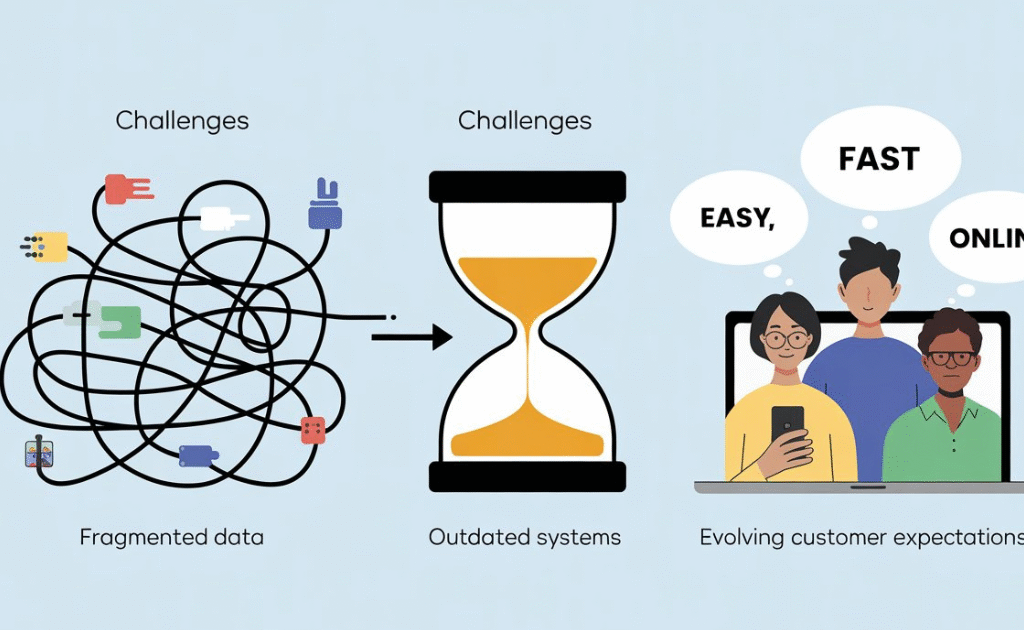
Fragmented Data and System Integration
Many real estate organizations struggle with data silos, where information is scattered across disparate systems like property management software, accounting platforms, and CRM databases. This fragmentation prevents a holistic view of operations and performance, often requiring manual aggregation and reconciliation, which is time-consuming and prone to errors. A well-developed website should serve as a central hub, capable of integrating with these systems to provide seamless data flow and a unified customer experience.
Overcoming Technological Disruptions and Outdated Systems
The real estate industry is undergoing a significant digital shift, but many companies find it challenging to modernize due to outdated systems, high upgrade costs, and a lack of in-house expertise. Clinging to outdated infrastructure leads to inefficiencies and can reduce tenant satisfaction and retention. Investing in modern web development means embracing new technologies that streamline operations and enhance the user journey, ensuring your business remains agile and competitive.
Meeting Evolving Customer Expectations
Today’s real estate customers expect speed, convenience, and digital accessibility like never before. They want to browse properties, book tours, and even sign leases online—without delays or paperwork hassles. Millennials and Gen Z, in particular, expect fast, mobile-friendly experiences, and platforms like Zillow and Airbnb have set high standards for convenience. Your web development strategy must prioritize these expectations, leveraging features like instant responses, personalized recommendations, and seamless online processes to attract and retain clients.
Ready to transform your real estate business with a powerful online presence? Click & Fill out the form to connect with our experts. Whether you’re looking for a custom website, advanced SEO strategies, or dynamic digital marketing campaigns, we’re here to provide a personalized consultation and help you unlock unparalleled growth and engagement in today’s competitive market. Connect Now
Conclusion: Your Agency’s Path to Unstoppable Digital Dominance
In the dynamic world of real estate, a strategic, well-developed website is no longer a luxury—it’s the cornerstone of sustained growth and engagement. By investing in a custom site that prioritizes credibility, user experience, and essential features like IDX integration and virtual tours, you establish a powerful digital headquarters.
Coupled with targeted SEO that leverages long-tail, high-intent keywords (e.g., “luxury beachfront homes for sale in Malibu” or “best real estate agent in [Your City]” ), your website becomes a magnet for qualified leads. Furthermore, integrating your web presence with broader digital marketing efforts—from engaging visuals to lead capture forms—transforms visibility into tangible conversions.
The real estate market is constantly evolving, and so too must your digital strategy. By proactively addressing challenges like data fragmentation and evolving customer expectations through modern web development, you position your agency as a forward-thinking leader. Embrace these strategies, continuously monitor your performance, and ensure your digital presence is as impressive and inviting as the properties you represent. This is your blueprint for not just ranking on Google, but for achieving unstoppable digital dominance in real estate.